
WELCOME BONUS 300%
UP TO €2000 + 100
FREE SPINS
UP TO €2000 + 100
FREE SPINS
Home → Blackjack
Blackjack at Beazt Casino: Variants, Rules and Payouts
Place Side Bets Before the Cards Are Dealt
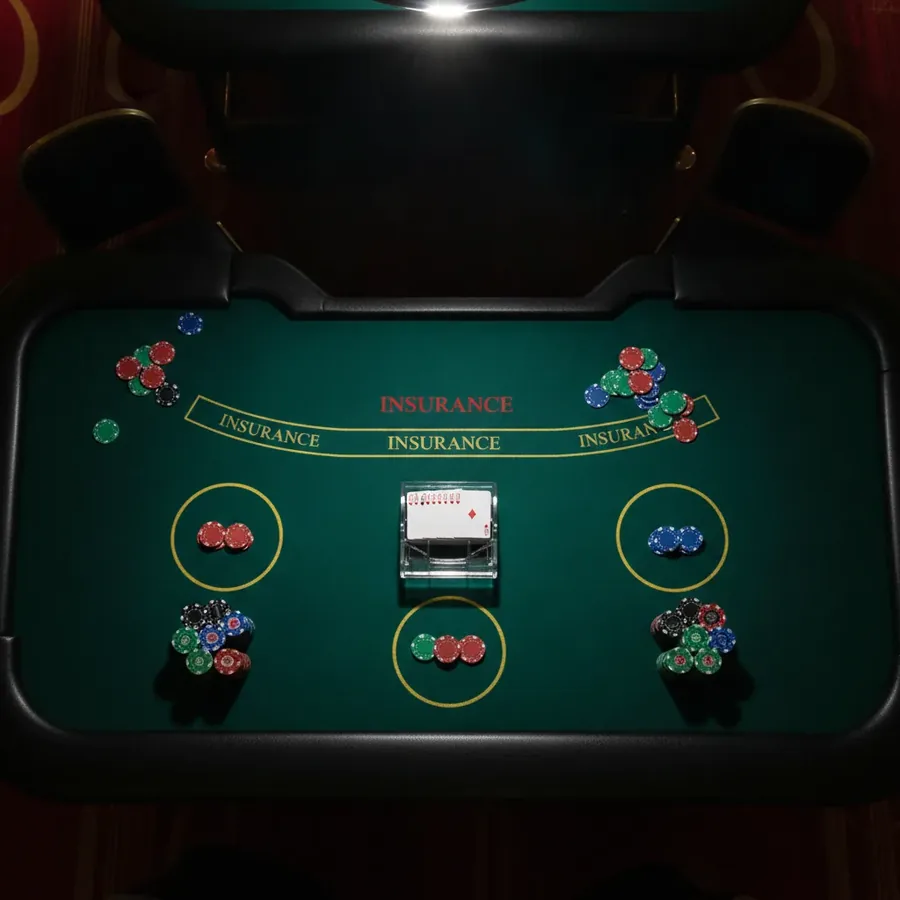
Insurance is offered when the dealer shows an ace and costs up to 50% of the main bet, carrying an RTP of 92.53% and a house edge of 7.47%, which is the average share of each stake the casino keeps over the long run.
Set that edge against the 0.46% of a six-deck game with S17, DAS, DOA and a 3:2 payout, where basic strategy is required to reach an RTP of 99.54%, and the gap becomes 7.01 percentage points.
On a €100 main bet the maximum insurance stake is €50, and the 7.47% edge costs about €3.74 of that side stake per placement, while basic strategy declines the bet except for card counters at a true count of +3 or higher. With a single deck the edge is about 5.88%.
How many decks are in the shoe?
A single-deck game with classic rules and a 3:2 payout reaches an RTP of 99.85% and a house edge of 0.15%, while eight decks sit roughly 0.48 percentage points lower, so the deck count alone moves the return by nearly half a point.
Six decks instead of eight add about 0.02 percentage points to the RTP, which on a €100 staked across 100 rounds is roughly €2 of expected value, and the six-deck benchmark with S17, DAS, DOA and 3:2 returns 99.54%.
The 6:5 payout on six decks drags the RTP down to 98.15% and lifts the house edge to 1.85%, since swapping 3:2 for 6:5 adds exactly 1.39 percentage points to the casino's edge, the largest single rule change in the set. On a €10 bet a blackjack then pays €12 instead of €15.
Surrender or Play On With 16 Against a 10
Late surrender lets the player give up the hand after the dealer has checked for blackjack and lose half the stake, improving the RTP by about 0.08 percentage points, and early surrender is worth up to 0.6 percentage points but is extremely rare.
The liberal Vegas Strip rule set combines S17, DAS, resplit and late surrender for an RTP of 99.72% and a house edge of 0.28%, with a standard deviation of 1.15, so surrendering on 16 against a dealer 10 is already priced into that figure.
On a €10 hand, surrender returns €5, while playing out risks the full €10 with the 0.28% edge applied to the rule set as a whole, and the double option instead puts stake ×2 at risk with one card drawn. Resplitting aces improves the RTP by 0.08 percentage points.
Insurance vs Even Money When You Hold Blackjack
Insurance pays 2:1 and is a separate side bet of up to 50% of the main bet when the dealer shows an ace, with an RTP of 92.53% and a house edge of 7.47%, while a standard 3:2 blackjack pays €150 on a €100 stake and a 6:5 blackjack only €120.
A six-deck S17, DAS, DOA, 3:2 game with basic strategy returns 99.54% and a 6:5 game drops to 98.15%, so taking even money at 1:1 on a €100 blackjack locks in €100 instead of the €150 the 3:2 payout would deliver.
The 7.47% insurance edge on a €50 side stake costs about €3.74 per placement, and basic strategy always declines it except for card counters at a true count of +3 or higher. With a single deck the insurance edge falls to about 5.88%.
Split Aces: Only One Card per Hand
Splitting allows up to four hands and split aces usually receive one card each, and resplitting aces improves the RTP by 0.08 percentage points, which the liberal Vegas Strip rule set folds into its 99.72% return and 0.28% house edge.
Doubling after a split adds about 0.14 percentage points of RTP, while the dealer hitting soft 17 lowers it by 0.22 percentage points, so H17 combined with a 6:5 payout on six decks leaves an RTP of 98.15% and a 1.85% edge.
On a €10 hand, a split creates two hands of €10 each with one card per ace, and the double option multiplies a single stake ×2 with one card, so a €10 double puts €20 at risk. The 3:2 payout still pays 1:1 on a regular win and 2:1 on insurance.
Blackjack variants at a glance
| Variant | Payout | House edge | Rule | RTP |
|---|---|---|---|---|
| Blackjack Single deck, classic rules, 3:2 | Blackjack 3:2, win 1:1 | 0.15% | Fewer decks = lower edge; one deck gives about −0.48 percentage points compared with 8 decks. Often offset by a 6:5 payout. | 99.85% |
| Blackjack Liberal Vegas Strip (liberal rules, 3:2) | Blackjack 3:2, win 1:1 | 0.28% | The most player-friendly rule set: S17 + DAS + resplit + late surrender. Standard deviation 1.15 | 99.72% |
| Blackjack 6:5 payout instead of 3:2 (6 decks) | Blackjack 6:5, win 1:1 | 1.85% | Replacing 3:2 with 6:5 adds exactly +1.39 percentage points to the casino's edge – more than any other rule change. On a €10 bet a blackjack pays €12 instead of €15. | 98.15% |
| Blackjack Insurance (6–8 decks) | Insurance 2:1 | 7.47% | Separate side bet of up to 50% of the main bet when the dealer shows an ace. Basic strategy ALWAYS declines it (except for card counters at a true count ≥ +3). With a single deck the edge is ≈ 5.88% | 92.53% |
| Blackjack Surrender (late surrender) – rule effect | 50% of the stake returned | −0.08 percentage points | The player gives up the hand after the dealer has checked for blackjack and loses half the stake. Improves RTP by about 0.08 percentage points. Early surrender is worth much more (up to −0.6 percentage points) but is extremely rare. | n/a (rule modifier) |
| Blackjack Split / double / H17 – rule effects | Double – stake ×2 with one card; split – up to 4 hands; split aces usually get one card each. | H17 +0.22 percentage points; RSA −0.08 percentage points; DAS −0.14 percentage points | Dealer hitting soft 17 lowers RTP by 0.22 percentage points; resplitting aces improves it by 0.08 percentage points; doubling after a split improves it by about 0.14 percentage points; 6 decks instead of 8 – about 0.02 percentage points. | n/a (rule modifiers) |
Early Surrender Is Gone From Many Tables
Early surrender is a rule that lets a player give up half the stake before the dealer checks for blackjack, and it is rarely offered because it is worth up to minus 0.6 percentage points in house edge. The common alternative, late surrender, can only be used after the dealer has checked for blackjack and improves the return by about 0.08 percentage points. On a €100 stake, late surrender returns €50 when the hand is abandoned, while early surrender would return the same €50 but under more favourable conditions.
The effect of early surrender is large: it reduces the house edge by up to 0.6 percentage points, which is nearly eight times the 0.08 percentage point gain from late surrender. For a player staking €100 per hand over 100 hands, that difference amounts to €60 in expected losses avoided, compared with €8 for late surrender. Few tables now include early surrender because of this cost to the casino.
Without early surrender, the best available rule is late surrender, which appears in liberal rule sets such as Blackjack Liberal Vegas Strip with an RTP of 99.72% and a house edge of 0.28%. That game also includes dealer stands on soft 17, doubling after a split, resplitting and late surrender. The absence of early surrender means players must accept a slightly higher house edge than the theoretical minimum.
Calling Late Surrender Correctly in Three Steps
Late surrender is a rule modifier that improves the return by 0.08 percentage points, and it can be executed in three steps. First, after the dealer has checked for blackjack and does not have it, the player decides to abandon the hand. Second, the player loses half the stake, so a €100 bet returns €50. Third, the hand ends immediately and no further cards are drawn.
The value of late surrender is modest but measurable: it reduces the house edge by 0.08 percentage points, which on a €100 stake over 100 hands saves €8 in expected losses. In comparison, doubling after a split improves the return by about 0.14 percentage points, and resplitting aces by 0.08 percentage points. Late surrender is therefore one of several rule modifiers that collectively lower the casino's advantage.
A game like Blackjack Liberal Vegas Strip, with an RTP of 99.72% and a house edge of 0.28%, includes late surrender among its player-friendly rules. Without late surrender, the same rule set would have a slightly higher house edge. For a player who uses basic strategy, registering late surrender correctly means abandoning only the weakest starting hands, such as a hard 16 against a dealer's 10.
Stop the Session After a 30 Percent Loss
A session stop at a 30 percent loss means that if a player starts with a €200 balance, the session ends when the balance falls to €140. This threshold is not a rule of the games but a personal limit. The house edge on a game like Blackjack 6 decks, S17, DAS, DOA, 3:2 payout, basic strategy is 0.46%, so €100 of stakes costs €0.46 on average.
Over 100 hands at €10 per hand, total stakes are €1,000, and the expected loss at a 0.46% house edge is €4.60. A 30 percent loss on a €200 starting balance is €60, which is more than twelve times that expected loss. The stop therefore triggers only after a substantial deviation from the average outcome.
For a game with a higher house edge, such as Blackjack 6:5 payout instead of 3:2, the house edge is 1.85%. At that rate, €1,000 in stakes costs €18.50 on average, and the same €60 loss threshold represents a smaller number of hands. The stop limit is thus reached more quickly on tables with less favourable rules.
Blackjack Party Has Two Hosts
Blackjack Party from Evolution runs as a live blackjack table with a bet range of 1.00 EUR to 1,000 EUR per hand. Two hosts present the round, so the table carries the same 3:2 blackjack payout and 1:1 win as a standard live blackjack game. A player staking 100 EUR on a blackjack receives 150 EUR, while a regular winning hand returns the stake plus 100 EUR.
The house edge on this table is set by the rules, not by the hosts. A 6:5 payout instead of 3:2 would raise the casino's edge by 1.39 percentage points, so a 100 EUR blackjack would pay 120 EUR rather than 150 EUR. That single rule change costs the player 30 EUR on every blackjack, which is why the 3:2 format matters more than the table presentation.
Insurance is offered as a side bet of up to 50% of the main bet when the dealer shows an ace, and it pays 2:1. The house edge on insurance is 7.47%, so 100 EUR of insurance stakes cost 7.47 EUR on average over the long run. Basic strategy always declines the side bet, which keeps the return on the main hand unchanged at the table's underlying 3:2 rate.
Soft vs Hard Hands in Practice
A soft hand contains an ace counted as 11, while a hard hand either has no ace or has an ace counted as 1. The distinction matters because dealer hitting soft 17 lowers the return by 0.22 percentage points. In a game where the dealer stands on soft 17, such as Blackjack 6 decks, S17, DAS, DOA, 3:2 payout, basic strategy, the RTP is 99.54% and the house edge is 0.46%.
If the dealer hits soft 17 instead, the house edge rises by 0.22 percentage points to 0.68% for the same rule set. On a €100 stake, that difference is €0.22 per hand. Over 100 hands at €10 per hand, total stakes are €1,000, and the additional expected loss is €2.20.
For the player, a soft hand such as an ace and a 6 (soft 17) can be hit without busting because the ace can become 1. A hard 17 cannot be hit safely. In Blackjack Liberal Vegas Strip, with an RTP of 99.72% and a house edge of 0.28%, the dealer stands on soft 17, which is more favourable for the player than hitting soft 17.
Stand-on-17 Rule and Its Meaning for Players
Blackjack 6 decks, S17, DAS, DOA, 3:2 payout, basic strategy runs at an RTP of 99.54% with a house edge of 0.46%, and the dealer stands on soft 17 in that rule set. The house edge is the average share of each stake that the casino keeps over the long run. On €100 of stakes that edge costs €0.46 on average, which leaves €99.54 returned to players.
Against the liberal rule set, the gap is measurable: Blackjack Liberal Vegas Strip (liberal rules, 3:2) reaches an RTP of 99.72% and a house edge of 0.28%, while the 6-deck S17 game sits at 99.54% and 0.46%. The difference of 0.18 percentage points comes from resplit and late surrender, which the S17 game does not include. A player staking €1,000 at the lower figure gives up €4.60 on average instead of €2.80.
Doubling after a split is allowed in the S17 game, and doubling after a split improves the return by about 0.14 percentage points. Doubling means the stake is doubled with one card, and a split creates up to 4 hands. The dealer standing on soft 17 keeps the game at one of the lower edges in the comparison, though the 6:5 payout version drops to 98.15% if that payout is attached.
The 3:2 Blackjack Payout Explained
A 3:2 blackjack payout pays €150 on a €100 stake, while a 6:5 payout pays only €120 on the same €100. The 3:2 game with 6 decks, S17, DAS, DOA and basic strategy holds an RTP of 99.54% and a house edge of 0.46%. On €100 of stakes the average cost is therefore €0.46, and the blackjack itself returns €50 more than under 6:5.
Replacing 3:2 with 6:5 adds exactly 1.39 percentage points to the casino's edge, which is more than any other rule change. Blackjack 6:5 payout instead of 3:2 over 6 decks shows an RTP of 98.15% and a house edge of 1.85%. On €1,000 of stakes that shift costs €13.90 extra on average, which is the price of the weaker payout alone.
Insurance sits next to the main bet and pays 2:1, but with 6 to 8 decks it carries an RTP of 92.53% and a house edge of 7.47%. Basic strategy always declines insurance except for card counters at a true count of at least +3. The side bet of up to 50% of the main bet is therefore the weakest option at the table, well below the 99.54% of the main 3:2 game.
Ignoring the Basic Strategy Chart: 1 Percent Wasted
Basic strategy is required to reach the 99.54% RTP and 0.46% house edge of the 6-deck S17 game with DAS and DOA. The house edge is the average share of each stake that the casino keeps across many hands. Playing without the chart moves the result away from that figure, because the 0.46% edge already assumes every correct decision is made.
The rule effects show how quickly the return moves. A dealer hitting soft 17 lowers RTP by 0.22 percentage points, resplitting aces improves it by 0.08 percentage points, and doubling after a split improves it by about 0.14 percentage points. A single rule change can therefore be worth more than a full percentage point of return across a session.
Moving from 8 decks to 6 decks is worth about 0.02 percentage points, and a single-deck classic 3:2 game reaches an RTP of 99.85% with a house edge of 0.15%. The single deck gives about 0.48 percentage points more than 8 decks, though a 6:5 payout often offsets that gain. The chart is what captures these differences hand by hand.
Bet Two Percent of Your Bankroll per Hand
A €1,000 bankroll at 2% per hand means a €20 stake, and Blackjack 6:5 payout instead of 3:2 over 6 decks carries a house edge of 1.85%. At that edge, €20 of stakes costs €0.37 on average per hand. Across 50 hands at €20 each, or €1,000 of total stakes, the expected cost is €18.50.
At the 0.46% edge of the 6-deck S17 game, the same €20 stake costs €0.09 per hand on average, and €1,000 of stakes costs €4.60. The difference between the two edges is 1.39 percentage points, which is exactly the cost of the 6:5 payout replacing 3:2. The stake size does not change the edge, only the money it applies to.
Live tables set their own minimums and maximums: Blackjack Party from Evolution runs from €1.00 to €1,000, Lightning Blackjack from €1 to €2,500, and Quantum Blackjack Plus Live from Playtech from €1 to €5,000. A 2% stake of a €1,000 bankroll, or €20, fits inside all three ranges. The bankroll rule therefore scales with the table limit rather than the other way round.
Contact
Live - online chat
Banking









Providers












Beazt Casino 2026